You Don't Rise to Your Goals. You Fall to Your Discipline.
Overview
Every entrepreneur has the same 24 hours. Every entrepreneur has access to the same AI tools, the same marketing playbooks, the same spreadsheets. So why do some people build million-dollar businesses while others grind for a decade and stay exactly where they started?
The answer isn't talent. It isn't luck. It isn't some secret piece of tech nobody else has discovered yet. The answer is a combination of five things most entrepreneurs either ignore or actively avoid because they're uncomfortable: purpose, marketing, discipline, structured planning, and the willingness to actually decide something instead of drifting through your day.
This isn't theory. This is a live breakdown of exactly how to close the gap between where you are and where you say you want to be - pulled straight from a Wednesday morning livestream that started with a quote from an Instagram comedian and ended with a rap. In between, there's a blueprint that can genuinely change how you run your business, if you're willing to actually use it instead of nodding along and closing the tab.
Here's the deal upfront: none of this works if you just read it and feel inspired for twenty minutes. This only works if you act on it before the day is over. Keep that in mind, because we're coming back to it at the end.
Why This Topic Matters
Here's the uncomfortable truth: most businesses don't fail because the product is bad. They fail because the owner never got clear on purpose, never took marketing seriously, never built real discipline, never turned their big dream into a number on a calendar - and never noticed that every day they didn't decide to act, they were quietly deciding to stay exactly where they were.
This matters right now more than ever because the entrepreneurial world is drowning in noise. New tools launch weekly. New platforms promise to be the next big unlock. New gurus promise shortcuts. And in the middle of all that noise, the fundamentals - purpose, marketing, discipline, planning, and decisive action - get treated like old news, like something you already "know" and don't need to actually practice.
That's the trap. Knowing these five things and living these five things are two completely different realities. You can know that discipline matters and still spend your morning scrolling instead of working. You can know that marketing matters and still hide behind "my product will speak for itself." You can know your goals and still never write down a single number or a single date.
This topic matters because it's the difference between an entrepreneur who's still talking about their dream in five years and one who's living it. And if you're honest with yourself about which category you're currently in, this is exactly the conversation you need to have today, not next month, not "when things calm down."
The Five Main Points
1. Stop Chasing Success. Start Chasing Purpose.
The whole conversation kicks off with a quote worth tattooing on your forearm: "Don't seek success. Seek purpose and let success find you."
This isn't feel-good fluff. It's a practical operating principle. When you wake up every day chasing "success" as some vague, undefined finish line, every decision becomes exhausting because you don't have a filter for what actually matters. But when you have a real purpose - a clear reason your work exists beyond the invoice - every decision gets easier, because you can run it through a simple filter: does this serve the purpose or not?
A goal like "build as many websites as possible" is boring, hollow, and does nothing for the world. It burns you out because there's no meaning attached to the grind.
A goal like "help small businesses present themselves at a price they can actually afford so they can win more clients" is a mission. It gives your daily work weight and direction.
Purpose doesn't require religion, doesn't require some grand cosmic calling - it requires you to ask a simple set of questions: Are you making people comfortable? Are you bringing them joy? Are you saving them money? Are you helping them make money? And who, specifically, are you doing it for?
This is exactly why some entrepreneurs spend 4, 8, 12 hours a day on tech work and end the day feeling completely empty - they've disconnected the work from any purpose bigger than the invoice.
The promise here is real, but it's not instant: dig deep into your purpose, give it your blood, sweat, and tears consistently, and the world eventually rewards you. Maybe not with a lottery-ticket payday, but with easier client acquisition, better-fit customers, and work that doesn't hollow you out.
The lesson: stop obsessing over the scoreboard and start obsessing over the mission. The scoreboard takes care of itself when the mission is real.
2. Great Marketing Beats a Great Product — Every Single Time.
This one stings for anyone who's proud of their craft, but it needs to be said plainly: a mediocre product with great marketing will always make more money than a great product with mediocre marketing.
This isn't a cynical take on the world - it's a description of how the world actually works, and ignoring it doesn't make it less true.
Think about McDonald's. Nobody's arguing the hamburgers are the best on the planet. And yet McDonald's is one of the most successful companies in human history, because the marketing machine behind it is elite.
New entrepreneurs consistently make the same mistake: they pour everything into being the best technician, the cheapest option, the smartest expert in the room - and then wonder why nobody's beating down their door. Being the best at your craft does not automatically attract clients. Marketing does.
Your business name is not your pitch. Nobody wants to buy "Allmond Consulting." Nobody wants to buy your last name stapled onto the word "Consulting." People want to buy outcomes - specific, tangible transformations they can picture in their own life or business.
The fix ties directly back to point one: become an outcome-based, purpose-driven business instead of a name-based or feature-based one. Speak to a specific audience about a specific mission, and market that mission louder and bigger than your competitors are marketing theirs.
This doesn't mean your product quality doesn't matter at all - it means quality alone is not a marketing strategy, and if you're relying on "my service is better" to win business, you're going to keep losing to competitors who understand this rule and you don't.
The lesson: stop hiding behind quality as an excuse not to market boldly. Get loud, get clear on your outcome, and market like your business depends on it - because it does.
3. Discipline Is a Decision, Not a Feeling — And Motivation Will Always Let You Down.
This is the heart of the whole show, and it deserves to be read slowly: Discipline is a decision made every time you're tempted not to. Motivation is a liar that shows up for five minutes and leaves. The gap between who you are and who you could be isn't talent - it's a thousand small, undisciplined choices nobody saw.
Sit with that for a second, because it reframes everything about how you should think about your daily habits.
Discipline isn't a checklist you complete once. It's an identity you build one small choice at a time - every time you're tempted to skip the work and choose to do it anyway.
Your current results - whether you're running a $20,000 business or a $20 million business - are not a mystery, and they're not a surprise. They're the receipts. They're the compounded evidence of a thousand decisions, good or bad, that got you exactly here. If you don't like where "here" is, the fix isn't wishing harder — it's changing the decisions.
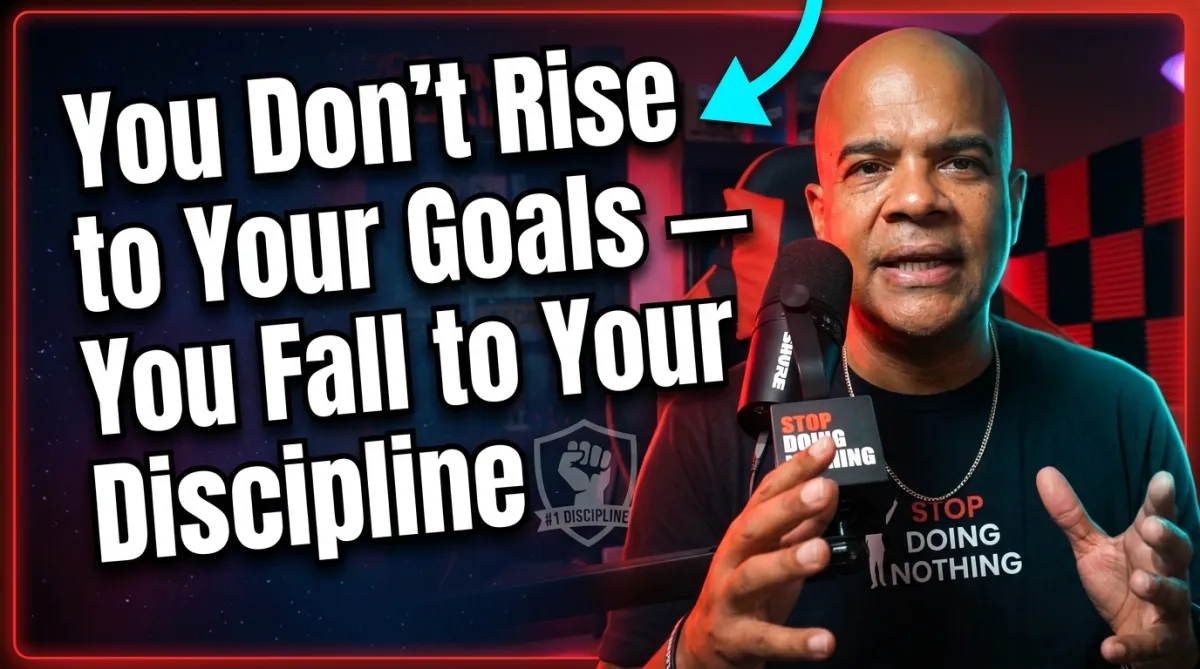
You don't rise to your goals. You fall to your discipline. You can set the most ambitious goal in the world, but on the day it actually matters - when your friends are out drinking and you should be working, when your friends are out on the lake and you should be training - you will fall back to whatever your discipline level actually is, not whatever your goals claim to be.
Nobody is coming to install this for you. Not an app. Not an AI tool. Not a productivity system. People were disciplined and getting things done long before smartphones existed. If you can't be disciplined with a crayon and a piece of paper, no amount of software is going to save you.
Inaction feels like safety, but it's a trap - it's failure wearing a disguise. Every day you refuse to decide is a day you've already decided, by default, to stay exactly where you are.
The lesson: stop waiting to feel motivated. Motivation is unreliable by design. Build the identity of a disciplined person through small, repeated, often boring choices - because that identity is what actually closes the gap between your current reality and your stated goals.
4. Turn Your Grandiose Goal Into a Number, a Date, and a Daily Task - Or It's Just a Wish.
Ambition without math is just a daydream. This point is about killing what's called the lie of casual goal setting — saying "I'd like to grow my business this year" and calling that a goal, when it's really just a wish with good intentions.
A wish has no number and no date. A goal has both. "I want to grow my business" is a mood. "I want to hit $5 million in revenue by September of next year" is a target you can actually build a plan around.
Scattered focus isn't ambition - it's fear of commitment wearing ambition's clothes. If you're chasing five different goals at once with no numbers attached to any of them, you're not being ambitious, you're avoiding the discomfort of committing to one specific, measurable outcome.
Once you have a real number, the math becomes almost mechanical. Want $5 million a year? Break it into monthly revenue, then break that into deal size, then break that into how many deals you need, then break that into how many leads you need at your team's close rate. Suddenly an overwhelming goal becomes a specific weekly action count you can actually hit.
The same logic applies to SaaS or subscription revenue: a million dollars a year at $497 a month per client comes out to roughly 168 paying clients. That's not an abstract dream anymore — that's a concrete, trackable number you either are or aren't moving toward each week.
This is exactly where AI earns its keep. Feed your big goal into an AI planning tool or agent, and let it help you reverse-engineer the goal into quarterly, monthly, weekly, and daily actions - then put those actions directly on your calendar so there's no ambiguity about what today requires of you.
Once the number is real and it's sitting in front of you every single day, it does something powerful: it makes the goal feel achievable instead of overwhelming, and it gives your discipline something concrete to aim at instead of a vague hope.
The lesson: an undated, unquantified goal isn't a goal - it's a wish dressed up to look like ambition. Put a number on it, put a date on it, break it into daily actions, and let the math do the motivating for you.
5. Every Day You Don't Decide, You've Already Decided - And Distraction Is Stealing the Only Life You Get.
This is the point that should genuinely unsettle you, because it's the one most people quietly ignore: every day you don't decide is a day you've decided by default to stay put.
Inaction is not neutral. It feels safe, but it's actively costing you. Choosing not to act on your goal today is still a choice — it's just a choice against yourself, made silently, without ever having to admit you made it.
Distraction isn't a minor inconvenience - it's actively taking hours out of the one life you get. Every scroll, every notification, every detour into an argument on social media is time you will never get back, spent on something that isn't moving you toward your purpose, your marketing, your discipline, or your goals.
"Someday" isn't on any calendar. If you finish something like this, feel genuinely fired up, and then let your phone ring or an email pull your attention away without taking a single concrete action - you've already told yourself, without saying it out loud, that whatever interrupted you matters more than what you claim to want for yourself, your family, and your future.
The fix isn't complicated, but it is uncomfortable: decide on purpose, on a schedule, in advance - instead of letting your day get decided for you by whatever demands the loudest attention in the moment.
The lesson: there is no neutral option here. You are deciding something every single day, whether you mean to or not. The only question is whether you're deciding on purpose, or letting distraction decide for you.
What Happens If You Don't Act
Here's the part that's easy to skip past, so don't. If you close this out, nod along, think "yeah, that was good information," and then go right back to reacting to whatever pings your phone next - nothing changes. Not because the information wasn't good enough, but because information was never the missing ingredient. Discipline was. Decision was.
The gap between the entrepreneur you are right now and the one you say you want to become isn't going to close itself while you wait for motivation to show up. Motivation isn't coming - it was never reliable to begin with. And every day you spend without a real purpose behind your work, without marketing loud enough to match the outcome you deliver, without a discipline system built on decisions instead of feelings, without your big goal broken into a number and a date, and without deciding on purpose instead of by accident - every one of those days becomes another receipt. Another piece of evidence for exactly where you'll be a year from now if nothing changes.
You already know this. That's the uncomfortable part. This isn't new information - it's a mirror. The only real question left is whether today is the day you finally act on it, or whether you close this tab and let "someday" quietly win again.
Don't let it win. Pick your purpose. Get loud with your marketing. Make the discipline decision the next time you're tempted not to. Put a number and a date on your goal today — not this weekend, today. And decide, right now, what the very next action is going to be, because the alternative is deciding, by doing nothing, to stay exactly where you are.
If this lit a fire under you, don't let it burn out in the next twenty minutes. Go watch the full, unfiltered show on YouTube at youtube.com/patrickallmond for the complete breakdown, the numbers on the whiteboard, and the energy you can't fully get from text. Or if you'd rather take this with you on your commute, at the gym, or while you're already out there taking action, subscribe to the full podcast on Apple Podcasts: Stop Doing Nothing Show.
Go subscribe, go put a number on your goal, and go make today the day the receipts start telling a different story.