The Quiet Habits Killing Your Business (I'm Guilty of All of Them)
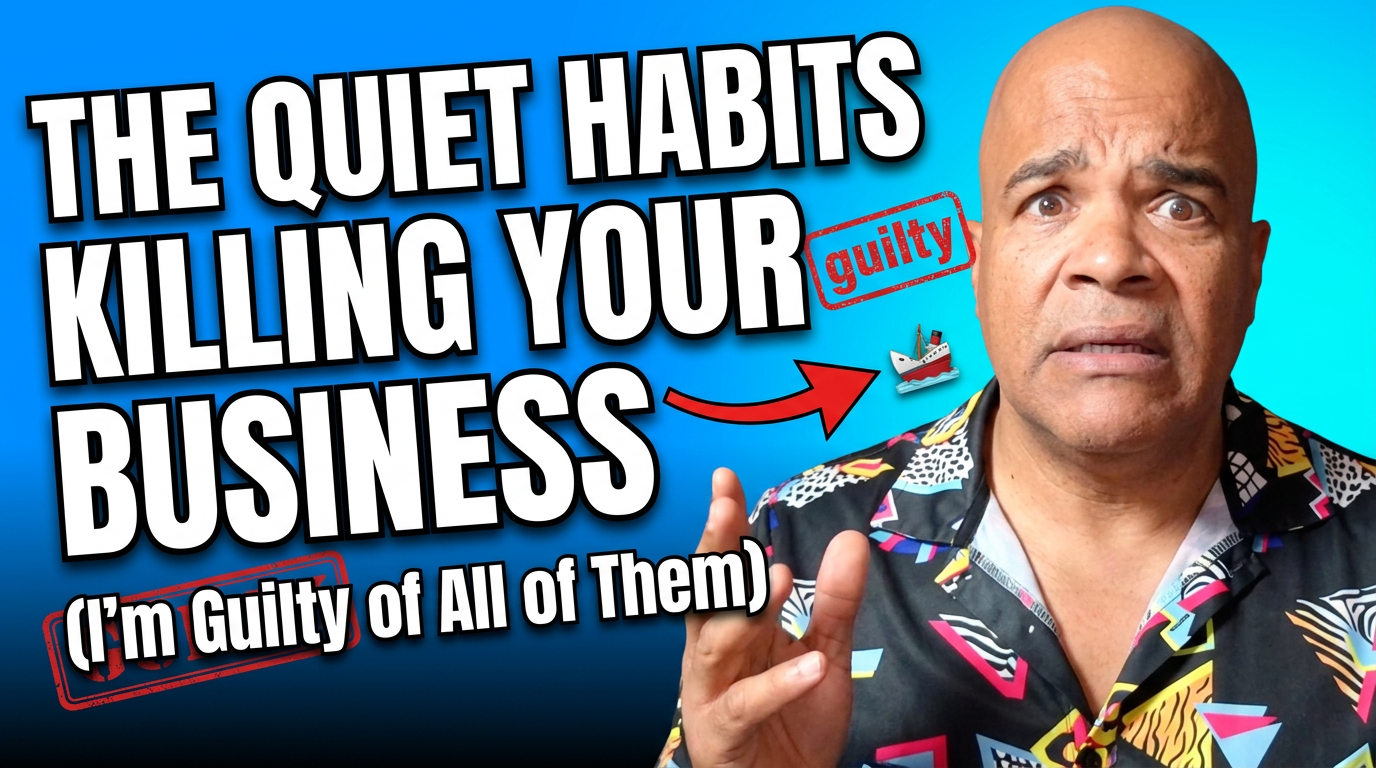
The Quiet Habits Killing Your Business (I'm Guilty of All of Them)
Overview
Most businesses do not die from one dramatic mistake. They get weakened by small, repeated habits that feel harmless in the moment.
One more hour of consuming instead of creating. One more week of waiting until things feel perfect. One more client accepted for the wrong reason. One more decision that keeps the owner at the center of everything. One more underpriced project that drains energy and trains clients to expect too much for too little.
That is what makes this topic so dangerous. These habits are quiet. They do not look reckless. They often look responsible, thoughtful, or productive. But over time they choke momentum, cash flow, confidence, and growth.
In this episode, Patrick takes a brutally honest look at self-sabotage in both life and business. He does not teach from a distance. He teaches from experience. He names the habits he has been guilty of himself and turns them into practical warnings for entrepreneurs who are trying to grow without accidentally becoming their own biggest obstacle.
If you are a founder, consultant, content creator, agency owner, coach, or service-based business operator, this conversation is for you. The core promise of the episode is simple: if you can identify the quiet habits that keep sabotaging your progress, you can replace them with more disciplined, more profitable, and more scalable behavior.
That matters because business growth is rarely just about strategy. It is about behavior. It is about what you repeatedly do when no one is forcing you. It is about whether your calendar, your pricing, your decisions, and your focus actually support the business you say you want.
This article breaks the show into the major ideas that matter most so you can spot the leaks, tighten the systems, and move with more intention.
Why This Topic Is Important
This topic matters because self-sabotage is expensive precisely when it does not feel expensive.
When entrepreneurs are stuck, they often look for bigger tactics: a new funnel, a new platform, a new software stack, a new ad strategy, a new branding angle, a new coach, a new morning routine. Sometimes those changes help. But often the real problem is simpler and more uncomfortable: the business owner keeps repeating habits that quietly cancel out progress.
That is why this conversation matters now.
The modern business world makes sabotage easy to disguise. You can listen to podcasts all day and feel informed while producing nothing. You can spend weeks polishing assets that have never touched the market. You can say yes to the wrong work because cash flow feels uncertain. You can keep every decision in your own hands and call it quality control. You can price too low and convince yourself you are being competitive. You can avoid your numbers and call it intuition.
None of that sounds dramatic. All of it is dangerous.
For ambitious business owners, the real risk is not only slower growth. The risk is becoming trapped inside a business model built around your own bad habits. If you create more than you sell, price from fear, delay action, and refuse to delegate, you do not just limit growth. You build a ceiling over your own head.
This is especially important for people building personal brands or expertise-driven companies. In those businesses, the owner’s mindset drives almost everything: sales, marketing, delivery, relationships, hiring, operations, visibility, and leadership. If the owner is trapped in sabotage cycles, the business reflects it immediately.
Patrick’s framing is powerful because he does not reduce self-sabotage to vague mindset talk. He gives it operational weight. These habits affect output, lead generation, delegation, margins, and sustainability. They are not abstract emotional issues. They are business issues.
There is also a leadership lesson here. A company cannot outgrow the habits of the person leading it for very long. If the owner constantly waits, underprices, over-controls, and avoids the truth in the numbers, the company absorbs those patterns. Teams slow down, decisions get bottlenecked, margins stay tight, offers stay muddy, and growth becomes harder than it needs to be.
The upside, though, is just as real.
Once you identify the habit, you can change the behavior. Once you change the behavior, you can change the results. That is why this topic is worth taking seriously. The entrepreneur who learns to create more than they consume, move before they feel perfectly ready, delegate without guilt, price for value, and track the real numbers gives themselves a far better chance of building something durable.
In other words, the quiet habits that kill a business can also become the quiet disciplines that save one.
Main Points From the Show
1. Consuming too much and creating too little will keep you feeling busy while staying stuck
One of the sharpest points in the episode is the warning about overconsumption.
For entrepreneurs, especially in the early stages, it is easy to confuse learning with progress. You can listen to podcasts, download PDFs, watch videos, join funnels, follow every expert, and spend your whole day surrounded by business content. That feels productive. It feels like work. But as Patrick points out, it can become a way to feel busy without actually being busy.
That distinction matters.
If you need leads, revenue, visibility, and momentum, then eventually you have to stop consuming and start doing. You have to build the funnel. Write the ad. Publish the post. Record the video. Send the proposal. Launch the campaign. Make the offer. Business owners do not get paid for understanding content. They get paid for acting on it.
Patrick makes this especially real by naming the tension directly. As a content creator, he wants people consuming the content. As an entrepreneur, he knows there has to be a cutoff point where consumption ends and execution begins.
That creates a practical challenge every business owner should think about:
- How much of your day is spent taking in ideas versus shipping work?
- Are you learning in order to apply, or learning in order to postpone action?
- Have you built a habit of studying everyone else’s content instead of making your own?
One of the strongest insights here is that most of the experts are saying many of the same things anyway. The basics of business success are not hidden behind the two hundredth podcast subscription. The bigger need is usually implementation, not more information.
If this habit is showing up in your business, the fix is not to stop learning altogether. The fix is to rebalance the ratio. Create more than you consume. Use content as fuel, not as a hiding place. Learn, then move.
2. Waiting to feel ready is just a prettier version of procrastination
Another major theme is the trap of readiness.
Plenty of entrepreneurs tell themselves they are almost ready. The offer is almost polished. The funnel is almost finished. The graphics are almost right. The automation is almost complete. The timing is almost ideal.
But “almost ready” has a way of becoming permanent.
Patrick pushes against this by using a deeply practical example from marketing. If the goal is to launch a funnel, the absolute first priority is getting the landing page live and getting traffic moving. The rest can often be built while ads are waiting for approval or while traffic is still warming up. In other words, the business does not always need the full machine completed before the first move happens.
That is a valuable lesson because perfectionism often disguises itself as professionalism. It sounds responsible to keep polishing. But when polishing delays proof, it becomes sabotage.
The show’s deeper message is this: action creates clarity faster than preparation alone ever will.
- You learn more from launching than from imagining.
- You learn more from feedback than from private tweaking.
- You learn more from moving imperfectly than from waiting elegantly.
This does not mean be reckless. It means sequence things intelligently:
- Build the minimum piece required to test the idea.
- Put it in front of real people.
- Use the waiting time and feedback loop to improve the next layer.
- Keep moving before doubt turns into delay.
For founders who have been sitting on offers, campaigns, workshops, products, or visibility plans, this point hits hard. The market does not reward the most privately polished idea. It rewards the idea that got put into motion and kept improving.
3. Staying the bottleneck limits the business to the size of your personal calendar
This is one of the most important business lessons in the episode.
Patrick describes a habit that crushes growth: keeping every decision, approval, client relationship, and key action flowing through the owner. When that happens, the business can only grow as far as the owner’s time, energy, and attention can stretch.
That may work at the beginning. In the earliest stage, you probably do have to open the doors, turn on the lights, take out the trash, create the content, serve the clients, and make the decisions. But if that never changes, the business becomes permanently dependent on your personal bandwidth.
That is not control. That is fragility.
The phrase that stands out here is that “no one does it as well as I do” becomes the ceiling. That mindset can feel justified. Sometimes it is even partly true. But it still creates a ceiling.
The better path is operational maturity:
- Document how things are done.
- Start brain-dumping processes early.
- Turn repeated work into SOPs.
- Let other people handle parts of the work at 60%, 70%, or 80% of your standard if it means the work actually gets done.
- Accept that done by a capable team member is often better than perfect inside your own head.
This lesson also connects to scale. A company that depends on one brain for everything is difficult to grow, difficult to sell, difficult to stabilize, and difficult to protect from burnout. Delegation is not just a productivity move. It is an infrastructure move.
The owner’s job eventually shifts from doer to coordinator, leader, seller, and decision-maker. If that shift never happens, growth stalls not because the market is weak, but because the business is chained to one person’s operating capacity.
4. Saying yes to everything can create cash today while damaging focus tomorrow
Patrick’s take here is nuanced and useful.
The obvious lesson is that saying yes to every client, project, and opportunity is dangerous. It often comes from fear of leaving money on the table, especially in feast-or-famine seasons. That kind of fear makes entrepreneurs accept work that is outside their best skill set, outside their positioning, or outside the type of business they are actually trying to build.
But the episode does not stop at the usual “just say no” advice.
Instead, Patrick points to a more strategic option: if the work sits near your core competency, sometimes you can still say yes and subcontract it. That lets you stay valuable to the client, keep the relationship, preserve margin, and build the identity of being a go-to resource without pretending you personally must execute every deliverable.
That is an important distinction.
There is a difference between taking random work that pulls you far away from your lane and taking adjacent work you can responsibly manage and deliver through the right people.
That requires judgment. The point is not “say yes to everything.” The point is “stop assuming your only choices are yes and do it all yourself or no and walk away.”
What matters most is intentionality:
- Is this opportunity close enough to your real value that it makes sense?
- Can you deliver it well through a contractor, specialist, or teammate?
- Will it strengthen the client relationship rather than confuse your positioning?
- Are you keeping margin, control, and quality standards in place?
When handled badly, saying yes to everything creates chaos. When handled wisely, selected yeses can become strategic partnerships, broader client trust, and new revenue streams. The discipline is in knowing the difference.
5. Underpricing from fear attracts the wrong clients and weakens the business
This section may be the most immediately profitable lesson in the whole show.
Patrick is direct about the danger of underpricing. Many entrepreneurs enter business wanting to be the best, the fastest, and the cheapest. That combination sounds attractive in theory, but in practice it becomes a nightmare. Low pricing often attracts price-sensitive clients, shrinks margins, creates resentment, and makes it harder to deliver quality work well.
Worse, it trains the business owner to think from fear.
Instead of asking, “What is this result worth?” or “What margin does this need to support quality delivery?”, the owner asks, “What price will keep me from being rejected?” That is not a pricing strategy. That is an approval strategy.
Patrick’s point is strong: if the only reason you lose the deal is that your price was too high, that is often a loss you can live with. A premium quote can protect your standards, give you delivery room, let you hire help, and make the work sustainable.
There are several practical lessons packed into this section:
- Do not try to win by being the cheapest.
- Price with enough margin to deliver quality and project-manage properly.
- Build options so clients can compare good, better, and best versions.
- Use pricing to steer the conversation toward value and outcomes, not toward panic and discounts.
The cheap-fast-good framework sits underneath this section too. Clients often want all three. Businesses rarely get to deliver all three. Part of sales maturity is helping people see that they are not buying a lower number; they are buying a result.
This matters because underpricing does more than shrink revenue. It creates operational weakness. Thin margins mean less help, less time, less flexibility, less patience, and more stress. Premium pricing, when backed by real value, gives the business room to breathe and room to serve.
6. Ignoring your numbers is one of the fastest ways to sabotage growth
Patrick closes on a habit that can quietly wreck even a busy business: not knowing the numbers.
Running on instinct alone may feel entrepreneurial, but it is not enough. You need visibility into margins, ad spend, customer acquisition costs, room costs, profitability, and the actual sales threshold required to make a campaign or event worth doing.
That is how good decisions get made.
When you know the numbers, you stop guessing. You know what success has to look like before the room fills. You know what each lead is worth. You know how much pressure a price point creates. You know when to push harder and when to pivot.
When you ignore the numbers, everything feels emotional.
- A low offer feels tempting because cash sounds good.
- An ad campaign feels exciting because activity looks good.
- A project feels promising because the client sounds enthusiastic.
But without the numbers, you do not know whether the business is getting healthier or just getting busier.
This is one of the most practical anti-sabotage disciplines available to any owner:
- Track the true cost of delivery.
- Know your minimum profitability targets.
- Measure what a lead costs and what a customer is worth.
- Review cash flow regularly instead of hoping it works itself out.
- Make pricing and growth decisions from data-supported confidence, not from vague emotion.
Numbers do not remove risk, but they reduce delusion. And for business owners, that alone can save enormous time, money, and energy.
Summary
The habits that destroy a business are not always loud. More often, they are subtle, repeated, and easy to defend. Consuming instead of creating. Waiting instead of launching. Controlling instead of delegating. Accepting everything instead of choosing strategically. Pricing from fear instead of value. Guessing instead of measuring. That is how good businesses slowly get strangled.
But the reverse is true too. Create more. Move sooner. Document and delegate. Choose work more strategically. Price with conviction. Know the numbers. Do that consistently and you stop being your own obstacle. You become the kind of leader your business actually needs.
If you ignore these lessons, the cost is not just slower growth. It is years of wasted effort, stress, and missed opportunity. But if you act on them, you give yourself a far better shot at building a business that is profitable, scalable, and sane.
Watch the full show on Patrick Allmond on YouTube and listen to the podcast on Stop Doing Nothing Show on Apple Podcasts to go deeper.