Stop Fighting AI. You Already Lost That Battle.
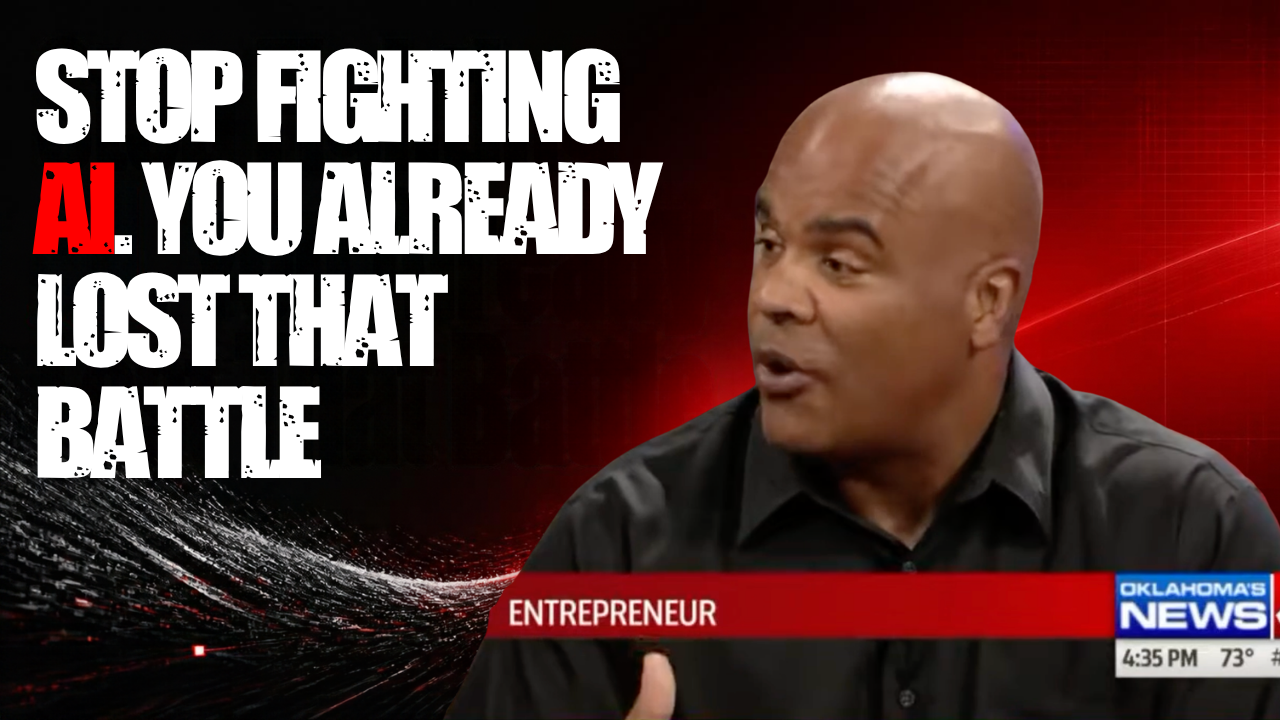
Stop Fighting AI. You Already Lost That Battle.
Most people are still talking about AI like it is a debate.
It is not.
It is already here. It is already changing how businesses create, think, market, sell, teach, document, automate, and scale. The argument over whether AI should exist is largely over. The real question now is whether you are going to learn how to use it well—or whether you are going to let other people use it to outpace you.
That is the core message of this episode. Patrick Allmond does not approach AI as a shiny toy or a theoretical future. He approaches it like a working business owner, speaker, marketer, and operator who is already building with it every day. His position is blunt: if you are trying to fight AI itself, you are fighting progress, and progress does not usually ask permission before it moves on.
This does not mean every use of AI is good. It does not mean every new tool deserves blind trust. It does not mean human judgment no longer matters. It means the business owner, marketer, creator, or leader who refuses to engage with this shift is making a costly mistake. The people who learn how to direct these tools will move faster, test faster, publish faster, build faster, and in many cases serve better.
If you have felt skeptical, overwhelmed, hesitant, or quietly resistant to AI, this conversation matters. It helps you separate the useful from the dangerous, the practical from the hyped, and the human from the lazy fear that often shows up whenever a major technological shift begins.
Overview
This episode is for business owners, marketers, creators, and leaders who know AI is changing the game but are still unsure how to think about it without getting swept up in panic or hype. Patrick’s core promise is simple: stop wasting energy trying to resist the existence of AI and start focusing on how to use it intentionally, profitably, and responsibly.
At the center of the conversation is a challenge. Too many people are treating AI like something they can delay until the dust settles. But the dust is not settling. Tools are improving, systems are getting smarter, and the people who learn how to use them today are building an unfair speed advantage over the people who keep waiting.
At the same time, Patrick makes an important distinction. Being pro-AI does not mean handing morality, life-and-death decisions, or deeply human judgment over to machines. There is a line. There are areas where automation can make life better and business stronger, and there are areas where human responsibility still needs to stay firmly in human hands.
That balance is what makes this episode useful. It is not blind evangelism. It is a direct, grounded case for learning how to use AI where it creates leverage, speed, clarity, and execution.
Why This Topic Is Important
This topic matters now because AI is no longer a niche subject for technologists. It is showing up in content creation, customer service, project management, operations, research, training, CRMs, ad workflows, note-taking, and knowledge management. In other words, it is entering the exact places where most modern businesses either gain momentum or lose it.
That creates both risk and upside.
The risk is obvious: if you ignore the tools that are helping your competitors move faster, you eventually end up losing on speed, responsiveness, cost, and experimentation. Someone else will publish more consistently, produce assets faster, organize information better, and build systems that require less manual effort than yours. They will not necessarily be smarter than you. They will simply be using more leverage.
The upside is just as powerful. AI can help turn rough ideas into usable first drafts. It can help business owners repurpose content, structure knowledge, summarize conversations, organize projects, and create repeatable systems. It can reduce friction between having an idea and getting that idea into the world.
That matters because most businesses do not struggle from a lack of ideas. They struggle from the gap between ideas and execution. They struggle from bottlenecks. They struggle from scattered notes, unfinished drafts, underused knowledge, delayed follow-up, and too much dependence on one person’s time.
Patrick’s framing turns AI into a practical business conversation instead of a science-fiction conversation. He is not asking whether machines will become sentient. He is asking a more relevant question for entrepreneurs: how do you use this wave to move faster, think more clearly, and build a stronger business without giving up the parts of humanity that still matter most?
If you engage the topic seriously, the reward is not just efficiency. It is strategic advantage. If you ignore it, the cost is not just slowness. It is getting buried by a shift that was never going to stop because you wished it would slow down.
Main Points From the Show
1. Fighting AI is really just fighting progress
One of the strongest ideas in the episode is also the bluntest: resisting AI itself is a losing strategy because progress rarely moves backward. Patrick argues that throughout history, once human beings find a technology that expands capability, increases speed, or reduces friction, they keep pushing it forward. They may regulate around it, argue about it, or fear parts of it—but they do not usually shelve it and go back.
That is why the current calls to “slow it all down” often miss the point. Technology does not pause simply because some people feel uncomfortable with how fast it is moving. Businesses, markets, creators, and entire industries adjust around new realities. The people who learn how to adapt usually outperform the people who spend all their energy resenting the change.
This is not a message about surrender. It is a message about where to direct your energy. If AI is here, then your job is not to pretend it is optional. Your job is to understand where it creates leverage, where it creates risk, and how to stay useful in a world where the tools keep getting stronger.
2. The winners will be the people who know how to use the tools with purpose
Patrick is direct about something many people do not want to hear: the people who are already in motion, already experimenting, and already building will use AI to widen the gap between themselves and everyone else. In his world of sales, marketing, media, systems, and business operations, AI becomes a multiplier. It helps experienced operators move bigger, better, and faster.
That should challenge passive observers. The advantage does not come from merely having access to the tools. Nearly everyone can access them now. The advantage comes from knowing what to do with them. It comes from applying them to real problems, real workflows, and real opportunities.
That is why casual curiosity is not enough. Business owners need to ask practical questions like:
Where am I repeating work that could be systemized?
Where am I stuck between ideas and execution?
Where does my business depend too heavily on memory instead of documented knowledge?
Where could AI help me create, organize, clarify, or repurpose faster?
Those are the questions that turn AI from entertainment into leverage.
3. There is a real line between helpful AI and harmful AI
One of the most important parts of the episode is that Patrick does not treat every use of AI as equally acceptable. He openly says there are areas where he is cautious, especially when it comes to decisions that affect human life, moral responsibility, or deeply human consequences.
That distinction matters because a lot of public conversation about AI collapses everything into one bucket. But AI that helps repurpose content is not the same as AI making life-and-death choices. AI that organizes notes is not the same as AI deciding who gets help and who does not. AI that helps create workflows is not the same as AI being trusted with the parts of society where human judgment carries moral weight.
This point strengthens the overall message of the show because it keeps the conversation grounded. You do not need to become blindly optimistic to become practically engaged. You can believe in using AI aggressively in business while still rejecting the idea that machines should replace human accountability in every context.
That balance gives business owners permission to move forward intelligently instead of emotionally. You do not need to become anti-AI or pro-everything. You need to become discerning.
4. AI shines when it helps turn ideas into real things
Patrick keeps returning to one of the most useful business lenses for AI: it shortens the distance between an idea in your head and an asset in the real world.
That is where many entrepreneurs should focus first. They already have ideas. They have concepts for content, offers, applications, processes, presentations, workshops, and systems. What they often lack is the speed or structure to turn those ideas into usable first versions.
AI can help with that jump.
It can help transform rough thoughts into outlines, outlines into pages, pages into assets, assets into campaigns, and spoken words into reusable content. It can help someone describe a concept, refine it, structure it, and begin moving it into form more quickly than they could alone.
Patrick pushes that idea even further with the vision of describing a physical product and eventually watching AI help route that concept through design tools into real-world fabrication. Whether that exact workflow becomes normal tomorrow or later, the principle is the same: AI is powerful wherever it helps translate ideas from one form into another.
That should matter to anyone who creates for a living. If you are constantly thinking, planning, teaching, selling, building, or communicating, then one of your biggest problems is not inspiration—it is friction. AI’s business value is often found in reducing that friction.
5. Creators should use AI as an amplifier, not fear it as a replacement
Another tension Patrick addresses is the fear that AI will destroy creativity. This concern is especially strong among artists, writers, musicians, and people who value originality. He acknowledges that concern, but he also reframes the opportunity. For the right creator, AI is not a replacement for vision. It is a tool for helping vision take shape faster.
That is a critical distinction.
AI cannot replace the taste, lived experience, judgment, emotional instinct, and point of view that make human creative work resonate. What it can do is help move from concept to draft, from draft to refinement, and from one format to another with far less friction than before.
That is why the better question is not “Will AI destroy creativity?” The better question is “How can creative people use AI without handing over the part that makes the work human?”
Used badly, AI can flatten originality. Used well, it can remove drudgery, speed experimentation, and create more room for real thinking. That matters not just to artists, but to anyone building thought leadership, content, training, messaging, or educational material as part of a business.
6. Most people are still at the beginning of AI maturity
One of the most practical frameworks in the episode is Patrick’s four levels of AI maturity. He makes the point that many people feel like they are “using AI” simply because they open ChatGPT or Claude and type into a prompt window. That is level one. It matters, but it is still the beginning.
From there, the maturity curve becomes more serious:
Basic AI commands: using chat-based tools for prompting, ideation, and one-off help.
Projects and local automation: using AI to build recurring assets, tasks, or automations that depend on local environments.
Managed agents: setting up AI agents that run on schedule, use instructions, and operate independently of your personal device.
Proactive agent systems with knowledge bases: building AI systems that not only run independently, but work from a large, structured body of knowledge and can coordinate ongoing work inside a business.
This framework matters because it helps business owners see the difference between dabbling and building capability. Typing into a chatbot is not the same thing as designing systems that can operate with memory, process, structure, and context.
It also helps explain why some people look unimpressed with AI while others are thrilled by it. They are often interacting with entirely different maturity levels. If you have only used AI for surface-level prompting, you have not yet seen what happens when these systems gain access to workflows, schedules, documentation, and institutional knowledge.
7. ClickUp, HighLevel, and Claude represent a practical stack for modern operators
Patrick also gets specific about the tools he would build around. If he had to narrow it down, his emphasis is on ClickUp, HighLevel, and Claude—what he jokingly describes as two and a half tools.
Why those? Because in his view they cover the core operational terrain. ClickUp becomes the second brain and knowledge base. HighLevel becomes a powerful business operating system for CRM and automation. Claude remains valuable as a direct thinking and creation tool.
The larger lesson is not that everyone needs the exact same software stack. The larger lesson is that serious AI adoption works best when it is connected to systems that already hold your work, your processes, your knowledge, and your follow-up. AI becomes far more useful when it can work inside the places where your business actually lives.
This is what many business owners still miss. They think AI is only about asking better questions in a chat box. But the future advantage often comes when AI becomes embedded in the environments where your knowledge, tasks, content, and decisions already exist.
Summary
You can keep fighting AI if you want. You can complain about the speed, debate the ethics in circles, and hope the world decides to pause until you feel more comfortable. But that is not how progress works. Progress moves. Markets move. Tools move. The people who learn how to use those tools move with them.
That does not mean you stop thinking. It does not mean you hand your humanity over to machines. It means you stop wasting energy pretending this wave is optional and start learning how to ride it with discipline. Use AI where it helps you turn ideas into assets, knowledge into systems, content into reach, and scattered effort into momentum. Draw hard lines where human judgment still belongs. But move.
If you do not, the cost is not just falling behind on a trend. The cost is letting more adaptive people build faster, serve faster, and organize better while you sit on the shore explaining why the wave should have waited.
If you are ready to stop resisting and start thinking more strategically, watch the full show on YouTube and listen to the full podcast for the complete conversation. Then decide where AI can help you move from hesitation to execution—because that is where the real advantage begins.